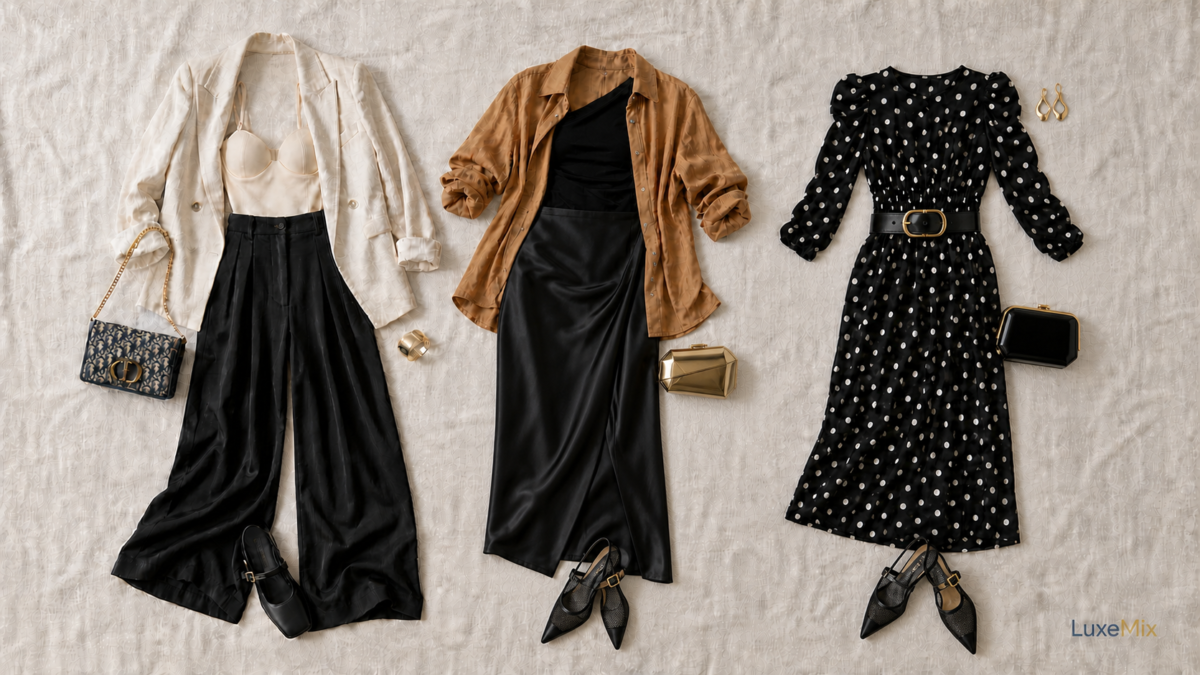
The version that starts with five pieces I already own—and refuses to hand me a straw hat.
After I wrote about what one night at Stanly Ranch did for me, I kept thinking about the less profound problem: what to pack.
Most Napa packing lists assume I want to become a different woman the minute I cross the county line. Floral dress. Espadrilles. Hat.
I wanted a capsule that could handle warm afternoons, winery air-conditioning, gravel, dinner, and one carry-on while still looking like me.
I uploaded five pieces I already own: an ivory bustier, ivory blazer, camel shirt, black-and-white dotted dress, and Dior chain bag. Then I made ChatGPT audit the actual pieces before styling anything. This matters. AI will happily remove a sleeve or redesign your bag if you let it.
The first board was going in the right direction, but the middle and right outfits still looked like ordinary daily life. I told it to glam them up. Denim became liquid black satin. The daytime bags became small evening clutches. A pointed mesh slingback replaced the sensible shoe.
That was the difference.
The prompt
Copy this into ChatGPT, fill in the brackets, and upload one to five pieces from your closet. It is long on purpose.
You are the Luxemix fashion editor. Create a modular capsule wardrobe for my Napa trip that feels edgy, polished, and evening-capable—not generic “wine-country chic.”

THE LUXEMIX DIRECTION

Combine Bay Area ease, Korean editorial restraint, and quiet luxury with a wink. The clothes should feel comfortable, current, lived-in, and deliberate.

Every outfit needs one or two controlled points of tension: an unexpected proportion, sharp accessory, high-low contrast, tactile material, directional shoe, or architectural detail. Polished alone is not enough, but “edgy” should never become costume-like.

Avoid:

- Head-to-toe beige without contrast
- “Old money” cosplay
- The floral-dress-and-straw-hat Napa cliché
- Fussy or matronly bags
- Loud logos, piles of studs, or too many statement pieces
- Impractical heels for gravel or extended walking
- Using red shoes, hats, or sunglasses as automatic shortcuts to edge
- “Flattering,” “age-appropriate,” slimming, or body-correction language

MY TRIP

- Dates or season: [ADD]
- Number of days and nights: [ADD]
- Planned activities: [travel, tastings, winery lunch, walking the property, spa or pool, dinner, etc.]
- Expected weather: [ADD OR ASK ME]
- Dress codes or reservations: [ADD]
- Walking and terrain: [ADD]
- Luggage limit: [ADD]
- Heel tolerance and comfort needs: [ADD]
- Preferred coverage: [ADD]
- Colors I love or avoid: [ADD]
- Budget: [ADD]
- Wardrobe-only or open to shopping: [ADD]

If important information is missing, ask me one concise round of questions before styling.

PIECES I ALREADY OWN

I may upload one to five photos of clothing, shoes, bags, or jewelry. I will label them Item A, Item B, Item C, and so on, with any known details.

Begin by auditing the uploads:

1. Identify each item by its label.
2. Describe only what is visible: category, color, silhouette, texture, construction, hardware, and scale.
3. Flag anything you cannot see clearly instead of guessing.
4. Treat each upload as a locked product reference. Do not recolor, redesign, resize, substitute, or invent logos and details.
5. Use every uploaded piece in at least one outfit and preferably two. If an item genuinely conflicts with the weather, itinerary, or capsule, explain why rather than forcing it.

PHASE ONE: CREATIVE DIRECTIONS

Propose three meaningfully different Luxemix capsule directions—not three cosmetic variations of the same blazer, trouser, and flat.

Change the silhouette engine, material story, and accessory logic in each direction.

For each direction, provide:

- A concise concept name
- Palette and silhouette
- Its intelligent point of tension
- The strongest reason to choose it
- One honest tradeoff

Wait for me to choose or revise a direction before building the final capsule.

PHASE TWO: BUILD THE CAPSULE

After I approve a direction, create a carry-on capsule of approximately:

- 8–9 apparel pieces
- 2 terrain-safe shoes
- 1 main bag
- An optional small evening bag only if it earns its space

Build a realistic sequence covering arrival and dinner, two tasting or lunch days with evening pivots, and departure or brunch. Do not invent an entirely new outfit for every event.

For each outfit, show:

- The specific occasion
- Every garment, shoe, bag, and accessory
- How to style it—tucked, cuffed, belted, layered, pushed-up sleeves, and so on
- The uploaded items used
- One or two controlled elements of edge
- The daytime-to-evening pivot
- A practical note for heat, winery air-conditioning, cool evenings, sun, gravel, or walking
- The strongest reason the look works
- Any real tradeoff

Repeat most core garments at least twice. Include one spill-tolerant tasting look. Keep every hem clear of the ground.

Each daytime base needs a removable layer that can also work at dinner. Shoes must be secure and genuinely walkable on gravel: no stilettos, delicate backless mules, or slick soles.

At least two evening looks must feel materially different from ordinary daytime clothing. Do not create “evening” merely by adding earrings to jeans and a shirt. Use a deliberate shift in silhouette, texture, proportion, or accessory architecture.

ACCESSORY DIRECTION

Give each outfit one edge-making hero plus one or two quiet supporting accessories.

Possible heroes include:

- An architectural or compact modern bag
- A strong belt used as visual architecture
- Sculptural metal jewelry
- A mesh or unexpected-texture detail
- A directional loafer, flat, boot, sneaker, or restrained low heel
- Dark eyewear only when it completes the concept

Accessories should finish the outfit’s point of view, not decorate it. Avoid “statement everything.”

FINAL OUTPUT

Provide:

1. Capsule inventory
2. Complete outfit formulas by occasion
3. Outfit-to-piece reuse matrix
4. Accessory plan
5. Packing checklist
6. Warm-day and cool-evening swaps
7. Any genuine wardrobe gaps

Do not provide shopping links unless I request them. Keep styling approval, shopping approval, and visual approval separate.

Remind me to check the final weather forecast 48–72 hours before traveling.

VISUAL PRESENTATION

After I approve the capsule, create a 16:9 Luxemix editorial flat-lay board featuring the three strongest looks.

Use:

- A tactile warm-ivory linen ground
- Soft, believable natural daylight
- Controlled navy, black, cream, taupe, brown, and restrained brass, adjusted when my uploaded pieces require it
- Three complete looks with equal visual weight
- Deliberate asymmetry and generous breathing room
- One shared hero piece to demonstrate capsule versatility
- Faithful rendering of every uploaded item

Do not add decorative flowers, coffee cups, books, excessive labels, invented trademarks, or miscellaneous lifestyle props. Preserve garment construction, hardware, texture, color, and scale.

The result should feel like Luxemix: relaxed, intelligent, polished—and just unexpected enough.
What ChatGPT gave me
Three directions. I chose Soft Armor, Warm Metal: bone, camel, black, deep ink, and burnished gold. Relaxed tailoring became the spine; the softer pieces kept it from feeling like a work wardrobe.
The three strongest formulas:
- Ivory bustier, oversized ivory blazer, wide black trousers, monogram chain bag, and architectural black flats.
- Camel shirt over an asymmetric black top, liquid-satin column skirt, burnished-metal clutch, and pointed mesh slingbacks.
- Black-and-white dotted dress sharpened with a black architectural belt, framed evening clutch, sculptural gold earrings, and the same mesh shoes.
What it got right, what it missed
Right: it built around my clothes instead of generating another shopping list. It separated the patterned bag from the dotted dress, reused the hero shoe, and gave every soft piece something sharper to push against.
Missed: the first pass was too sensible. The middle and right outfits looked like ordinary daily life.
The fix was not more accessories everywhere. It was one stronger material or silhouette decision in each look. Satin instead of denim. A framed clutch instead of an everyday bag. A directional shoe repeated twice so the capsule still made sense.
AI’s idea of polished is often just safe. You still have to tell it when the outfit has no point of view.
The rule you can steal
Upload the closet before you ask for the outfit.
“Edgy” and “polished” are not useful constraints by themselves. Actual garment photos, weather, terrain, luggage limits, shoe limits, and the requirement that every piece work twice are.
Give ChatGPT the packing math. Keep the veto.
That is the whole thing.
xo, Jenni