When life changes before your closet catches up, neutral outfit ideas can offer a low-pressure place to begin. Start with one repeatable formula, then change one variable at a time.
Simple outfit formulas for seasons of change—postpartum, divorce, menopause, a new career, or any chapter when your old wardrobe stops feeling like you.
There are seasons when getting dressed feels like one more open tab.
After a baby, a divorce, menopause, a career change—or some private shift that does not have a neat label—the clothes in your closet may belong to another version of your daily life. Maybe your body changed. Your schedule changed. The rooms you need to walk into changed.
The old formulas stop feeling automatic.
That does not mean you need to buy a new identity.
You need a place to begin.
The neutral outfit formula
This outfit closes a few of those tabs.
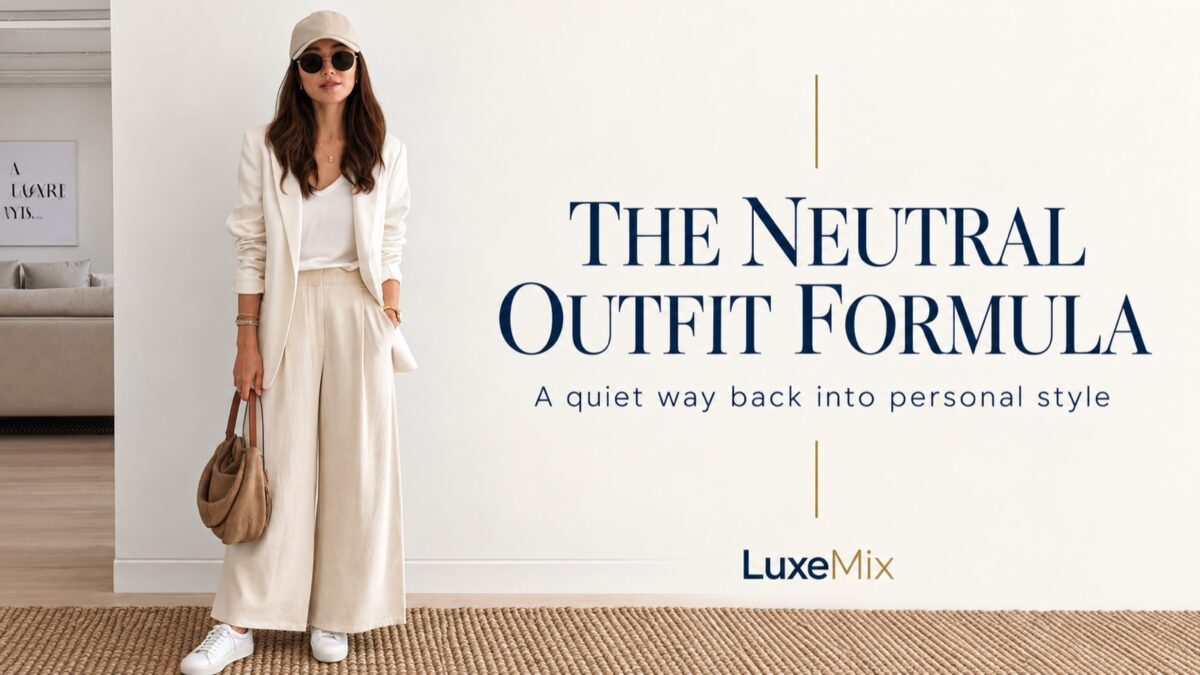
A soft-white blazer sits over a simple V-neck tee. Wide-leg trousers keep the shape easy. White sneakers ground it in real life. Then a baseball cap, black sunglasses, gold jewelry, and a slouchy woven bag keep all that cream from turning flat or precious.
This is not a shopping list. It is outfit math.
Start with one soft layer. Keep the base tonal. Change the scale with a wider or more relaxed trouser. Ground everything with an everyday shoe. Finish with one accessory that changes the texture or temperature of the outfit.
One layer. One base. One relaxed bottom. One practical shoe. One warm-texture accessory.
Repeatable is a feature.
Why neutral style can help during a transition
Neutral style is not about disappearing. It simply removes a few color decisions so you can pay attention to shape, proportion, texture, and how the clothes work with the day you are actually having.
That can be useful when the rest of life is asking for answers.
Postpartum can change your body and your routine faster than your wardrobe catches up. Divorce can make familiar clothes feel connected to a role you are no longer playing. Menopause can shift fit, temperature, comfort, and what you want touching your skin. A career change can alter both the dress code and the person you need to be in the room.
Different transitions. Same closet problem.
The old signals no longer work.
A simple neutral formula gives you a controlled experiment. You are not declaring a permanent new identity. You are gathering evidence about what still feels like you.
Three neutral outfit ideas to try
1. Soft tailoring with wide-leg trousers
Start with a blazer, simple tee, wide-leg trousers, and clean sneakers in closely related shades. Add a woven bag, suede belt, or warm metal jewelry so the outfit has depth.
The blazer brings structure. The sneakers keep it connected to real life.
2. A relaxed knit with straight trousers
Pair a soft cardigan or knit jacket with a tonal tank or tee, straight trousers, and loafers or low-profile sneakers. Keep the colors quiet, then add one darker accessory for contrast.
This version has less structure and more ease—useful on days when comfort needs to lead.
3. A monochrome base with one long layer
Build a simple column with a top and trousers in the same color family. Add a trench, long cardigan, or lightweight coat, then finish with a practical shoe and one bag with texture.
The long line does most of the visual work. You do not need five interesting pieces competing for attention.
Shop your closet first
Pull four pieces in the same color family: a light jacket or knit, a simple top, a relaxed trouser, and an everyday shoe. Then add one accessory that changes the texture—a woven bag, a dark belt, a suede cap, or a brass cuff.
Take a mirror photo.
Do not ask whether the outfit is “flattering enough.” Ask what the balance is doing. Does the shape feel grounded? Does one piece provide structure? Is there enough contrast to keep the outfit from feeling blank? Can you wear it through the actual day in front of you?
Keep the part that feels useful. Change one variable at a time.
Finding your style again does not have to start with becoming someone new. It can start with one outfit you understand.
That is enough for one morning.
Liked this?
Stay in the Loop
New posts and honest conversations, delivered to your inbox. No noise, just the writing.
L U X E M I X
N°150 · Vol. XX · September 2026
Twenty years in the making. A space for the messy, beautiful middle.