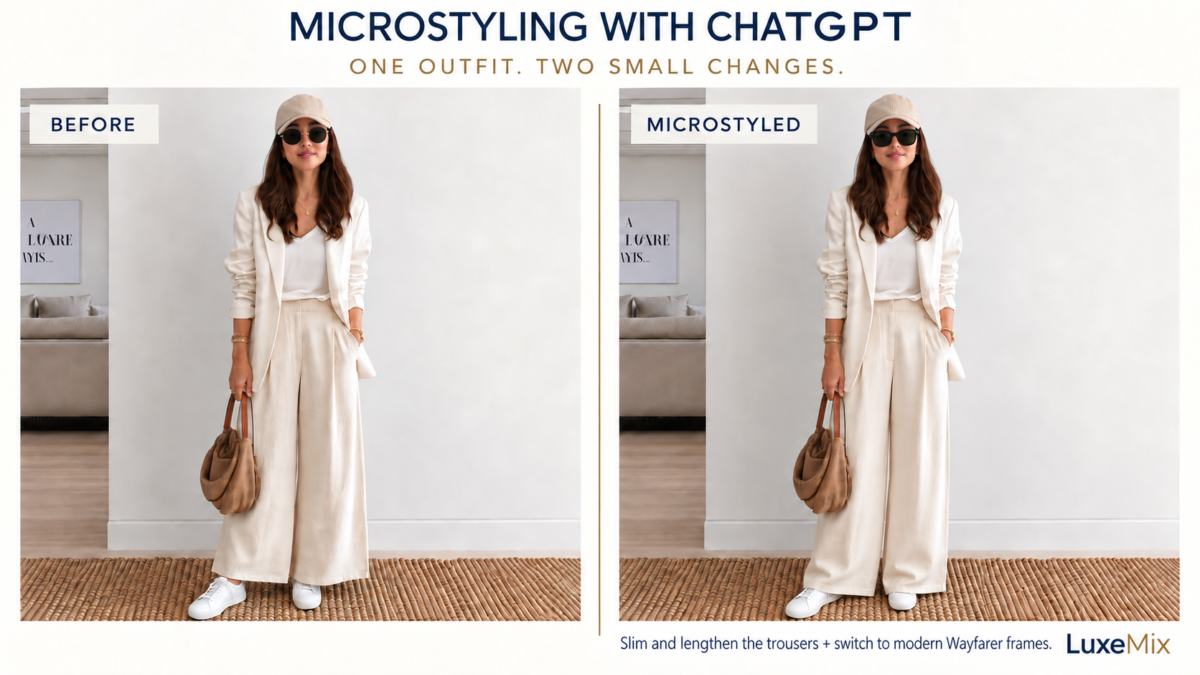
The prompt I use to get three small styling options—without changing the outfit I already chose.
Sometimes I can look at an outfit for so long that I stop seeing it.
I know the blazer. I know the trousers. I have already changed the shoes twice. By the time I am standing in front of the mirror, I am too close to notice that the sleeve needs pushing up or the shirt might look better with a small front tuck.
I do not need a new outfit.
I need a fresh pair of eyes.
That is how ChatGPT has become a useful style partner for me. I take a photo of what I am wearing, upload it, and ask for a few small adjustments I can try. Not a makeover. Not a shopping list. Just choices.
Takeaway: You may not need different clothes. You may need enough distance to see the clothes you already chose.
What I mean by Microstyling
Microstyling is changing one small variable while keeping the identity of the outfit intact.
It might be a partial tuck. A pushed-up sleeve. A belt moved slightly higher. Hair tied back so the neckline can do its job. One neutral layer added because the outfit needs texture—not because it needs to become something else.
The pieces stay. The direction stays. I am simply testing the finish.
This is especially useful when I am rebuilding my sense of style. During postpartum, divorce, menopause, a career change, or another transition, a full reinvention can feel like one more impossible project. Microstyling gives me a smaller unit of work.
One outfit. One variable. One decision.
Takeaway: Microstyling does not replace your outfit. It helps you finish it.
Why ChatGPT works as a fresh pair of eyes
ChatGPT can analyze an uploaded image and respond to specific visual questions. That makes it good at noticing relationships: where a hem lands, how two volumes interact, whether one accessory is carrying too much visual weight, or whether repeating a color would make the outfit feel more connected.
It does not know how the clothes feel on my body. It does not know what room I am walking into or which version of myself I want to bring there. That part is still mine.
But it can help me see what I have stopped seeing.
Takeaway: Use AI for pattern recognition, not permission.
Why I ask for three styling choices
I do not ask ChatGPT for the one correct answer because style does not work that way.
I ask for three options with different jobs:
- The smallest tweak—something I can do in ten seconds.
- The proportion option—a small adjustment to line, length, or volume.
- The finishing option—a detail involving an accessory, layer, sleeve, neckline, or hair.
That gives me a menu, not a mandate. I might choose the first option, combine part of the second with my own idea, or decide that the original outfit was already saying what I wanted it to say.
All three outcomes are useful.
Takeaway: Ask for choices, not a verdict.
The exact ChatGPT Microstyling prompt I use
Look at this outfit as a fresh pair of eyes and suggest three small, reversible styling adjustments—not a new outfit.
Preserve the overall direction, color palette, proportions, and level of dressiness. Do not replace a major piece, recommend shopping, comment on my body, or judge whether the outfit is flattering.
Each option should change only one thing. Prioritize adjustments using what I am already wearing, such as a partial tuck, sleeve or cuff adjustment, belt placement, opening or closing a layer, moving an accessory, or changing my hair. If helpful, one option may add a simple neutral layer or accessory I may already own.
Give me:
- Smallest tweak—what to change, why it works, and how to do it
- Proportion option—what to change, why it works, and how to do it
- Finishing option—what to change, why it works, and how to do it
Then tell me which option you would try first.
The guardrails matter. Without them, AI tends to treat the assignment like a blank page. I am not giving it a blank page. I am giving it an outfit I already chose.
Takeaway: “Change one thing” is the constraint that keeps the advice useful.
What I keep—and what I ignore
Sometimes ChatGPT points out exactly what I could not see. Sometimes it suggests something that does not feel like me.
That is fine.
I am not outsourcing my taste. I am using another set of eyes to uncover possibilities. My own reaction is still the most important signal: yes, no, or almost—but I would do it this way.
ChatGPT suggests.
I decide.
Takeaway: The tool can widen your choices without becoming the authority on your style.
Try Microstyling with your next outfit
Start with a real outfit on a real day. Take a mirror photo, crop out anything private in the background, upload it to ChatGPT, and paste in the prompt.
You do not need a perfect photograph. You do not need to identify every brand. And you definitely do not need to buy anything.
If you want an easy outfit to test, start with my neutral outfit formula for finding your style again. Build the basic look, take the photo, and change one variable at a time.
The goal is not perfection.
It is seeing what is already there—and choosing what feels like you now.